A straight-talk look at what’s actually happening in Yaletown, Coal Harbour, and the broader condo market
If you’ve been watching the downtown Vancouver condo market lately — whether you’re thinking about buying, selling, or just trying to make sense of it all — you’ve probably noticed things feel different. Listings are sitting longer. Prices have softened. And buyers, for once, aren’t rushing.
So what’s actually going on?
The short answer: it’s not one thing. It’s several forces that converged at the same time, and together they’ve fundamentally shifted the balance of power in neighbourhoods like Yaletown and Coal Harbour. Here’s a clear-eyed breakdown.
1. Too Much Supply, Not Enough Demand
Let’s start with the most straightforward reason: there’s more inventory than buyers right now.
Downtown Vancouver is sitting at over 1,000 active condo listings, and the sales-to-active-listings ratio has dropped well below the threshold that defines a balanced market. According to Greater Vancouver Realtors data, the overall Metro Vancouver market is firmly in buyer’s market territory, with a ratio of just 13.5% — anything under 12% is considered a buyer’s market, and we’ve been hovering right at that edge.
What pushed inventory this high? A wave of condo completions. Many projects that launched during the boom years of 2020–2022 are now finishing construction and entering the resale market all at once. That supply surge hit just as demand was cooling — a timing problem that created the overhang we’re dealing with today.
2. Immigration Pulled Back — and It Showed Up Fast
This one doesn’t get talked about enough, but it’s one of the most significant drivers of the current slowdown. For years, Vancouver’s condo market was underpinned by population growth. International students, temporary foreign workers, and new permanent residents consistently drove rental demand — which in turn supported investor purchases of condos. That equation worked reliably, until it didn’t.
Over the full 2025 calendar year, Canada’s population fell by 102,436 people — a 0.2% decline.
In 2024 and 2025, the federal government dramatically reduced immigration targets, particularly for temporary residents. The Canada Mortgage and Housing Corporation reported that Vancouver’s rental vacancy rates hit their highest levels in over 30 years in 2025. Meanwhile, CBC News reported that B.C. actually recorded a net population decline in early 2025 — 2,357 fewer residents compared to the prior quarter.
When the tenant pool shrinks, investors get nervous. And when investors step back, condo demand drops significantly — especially in dense urban neighbourhoods like Yaletown and Coal Harbour where invstor-held units make up a meaningful share of the market.
Canada’s population fell by 102,436 people in 2025
Net migration is simply the difference between how many people arrived in BC and how many left — combining both international arrivals (immigrants, students, temporary workers) and people moving between provinces. When the number is positive, more people came than left. When it goes negative, more people walked out the door than walked in. For a condo market that was built on the assumption of perpetual population growth, a swing from +24,817 to −15,739 in a single year is a significant demand shock.
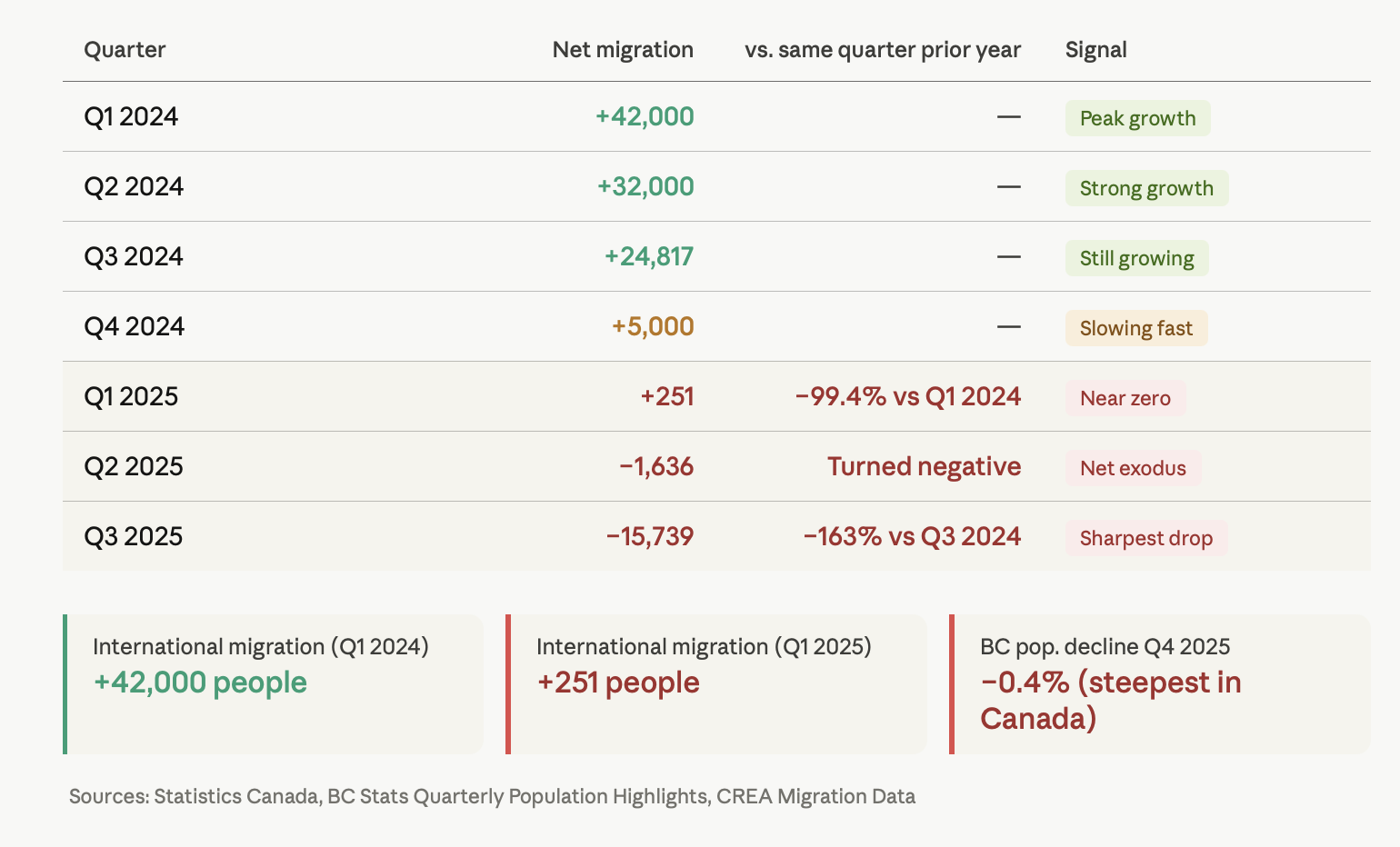
BC net international migration by quarter, Q1 2024 to Q3 2025. Source: Statistics Canada, BC Stats.
The Q1 comparison is the one that really tells the story — BC went from welcoming 42,000 net new people in a single quarter to just 251 in the same quarter one year later. That’s not a slowdown, that’s a near-complete stop.
And Q3 2025 flipping negative means BC is now actually losing people on net — more are leaving than arriving. For a condo market in Yaletown and Coal Harbour that was priced on the assumption that demand would keep coming, that’s a structural problem, not just a blip.
BC posted the steepest population decline of any province
Q4 2025 — the exact BC net migration number isn’t broken out in the sources, but what Statistics Canada did confirm is that BC recorded the highest quarterly population decrease of any province at −0.4%, driven by a sharp drop in non-permanent residents. Nationally, Canada’s population fell by 103,504 people — a 0.2% decline — as non-permanent residents dropped by 171,296 in that single quarter alone. CBC News
Q1 2026 — Statistics Canada’s preliminary estimate placed Canada’s total population at 41,472,081 as of Q1 2026, but BC-specific net migration figures for that quarter haven’t been published yet. That data typically releases with a 2–3 month lag, so it’s not available as of today. WES
3. Investors Went to the Sidelines
Closely tied to the immigration shift is the retreat of the investor buyer. This segment was a major force in driving downtown condo prices higher through the pandemic years, and their absence is being felt.
As Royal LePage CEO Philip Soper explained, lower interest rates were supposed to bring investors back — but the rebound never fully materialized. “A big part of that was their clients, their tenants, disappeared with the much smaller quotas,” Soper told BNN Bloomberg. Without reliable rental income to justify the carrying costs, the math on buying a condo as an investment stopped making sense for many.
RBC Economics echoed this, noting that investor demand in urban condo markets like Vancouver is expected to remain subdued through this cycle. Re/Max Canada reported that Greater Vancouver condo sales fell 11% year-over-year through the first ten months of 2025, with average prices declining nearly 6% to around $765,000.
4. Interest Rates Cut, But Confidence Didn’t Fully Follow
The Bank of Canada cut rates meaningfully through 2024 and into 2025. By April 2026, the overnight rate sat at 2.75%, bringing five-year fixed mortgage rates down to the 4.10–4.45% range. On paper, that should have been enough to reignite buyer activity.
But here’s what the data shows: affordability improved, yet sales stayed sluggish. Why? Because rate cuts alone don’t restore confidence. Buyers were also weighing job security, broader economic uncertainty, and the noise around U.S. tariffs — all of which created hesitation even when the mortgage math improved.
Re/Max Canada summed it up well: buyers are seeking broader economic improvement and greater market stability before re-entering. The rate cuts opened the door. Many buyers are still deciding whether to walk through it.
5. Softer Rents Changed the Calculus
One quieter consequence of rising vacancy rates has been softening rents. Average rents across Metro Vancouver dipped roughly 3–5% for one- and two-bedroom units through 2025. For owner-occupiers, that’s a footnote. For investors evaluating whether a condo makes financial sense to hold, it’s a material shift.
CMHC has flagged that elevated vacancy rates are expected to persist through 2026 and into 2028 as new rental supply continues to come online. That sustained pressure on rental income is one more reason investor demand hasn’t recovered, and likely won’t in the near term.
What This Means for Yaletown and Coal Harbour Specifically
Both neighbourhoods feel this pressure acutely because of who typically buys there. Yaletown and Coal Harbour attract a mix of end-users and investors, with a higher concentration of upper-mid and luxury product than most of Vancouver. In a market where buyers have leverage, that segment tends to feel the most friction — buyers at the $1M+ price point are rarely in a rush, and they know it.
Coal Harbour in particular has seen softness at the higher end. According to downtown Vancouver market data from April 2026, units priced between $1.75M and $2M in Coal Harbour represent some of the best value opportunities for buyers right now — a telling signal about where negotiating room currently exists.
In Yaletown, the 1- and 2-bedroom segment is holding relatively better, with stronger sales velocity compared to larger units. The lifestyle premium of the neighbourhood — the seawall, the restaurants, the walkability — continues to underpin demand. But even Yaletown isn’t immune to the broader currents.
So Is This a Bad Time to Buy or Sell?
That depends entirely on your situation — but here’s the honest framing. Why Are Yaletown, Coal Harbour & Downtown Condos Dropping?For buyers, this is one of the most favourable entry points in years. You have inventory to choose from, time to do proper due diligence, and genuine negotiating power. That’s rare in this market. For sellers, pricing strategy matters more right now than at any point in recent memory. Overpriced listings are sitting. Well-priced, well-presented properties are still selling — they just need to be positioned correctly from day one.
The fundamentals of Yaletown and Coal Harbour haven’t changed. The location, the lifestyle, the long-term scarcity of quality urban product — none of that has gone anywhere. What’s changed is the short-term balance of supply and demand, and markets correct. They always do.
Thinking about buying or selling a condo in Downtown, Yaletown or Coal Harbour? I’ve been working in this market since 2016 and I can tell you exactly where the opportunities are right now.
Selling and buying in this market isn’t impossible — it just requires the right strategy from day one. Let’s talk about yours
Connect with me here @yuliyalys.realestate